DOCS
How the tubers work, where the money goes, and how to verify every claim on this page yourself. 4,444 tubers · ERC-721 · one canonical WETH pool · burn to plant · Robinhood Chain.
The Short Version Copy link
POTATOTRONS is two things that never turn into each other.
The tubers. 4444 potato computers, an ordinary ERC-721 collection on Robinhood Chain. You mint one from the seed bag, or buy one on a marketplace; it sits in your wallet and trades like any NFT. A tuber is never a token and a token is never a tuber. No dissolve, no reroll, no swap-out.
The token. $POTATRON is a fixed-supply ERC-20 — 4,444,000 units, no team allocation, no mint function — trading through one canonical POTATRON/WETH pool. Every buy and sell pays a permanent 3% fee enforced by the token itself: 2% of volume flows to planted tubers as agribusiness stock, 0.5% compounds locked liquidity, 0.25% pays tribute to the two parents, 0.25% pays the creator.
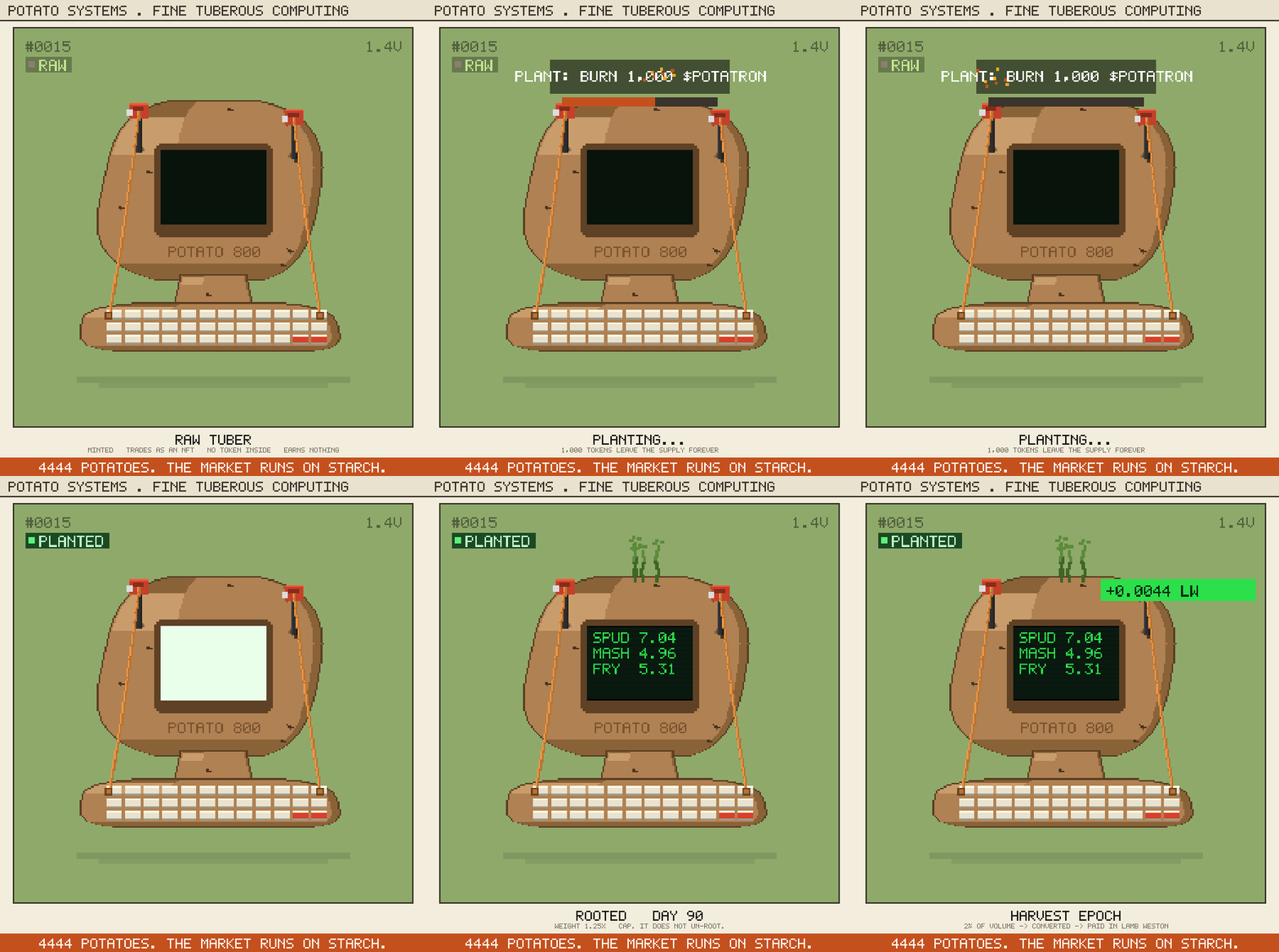
The door between them is one-way. Burn 1,000 $POTATRON into a tuber you own and it is planted: permanent, irreversible, screen lit, harvesting its track's stock from that moment on. The token supply shrinks with every plant; the fee stream it earns from does not. Planted tubers grow: weight rises at day 30 and day 90, and the clock belongs to the tuber, not the wallet.
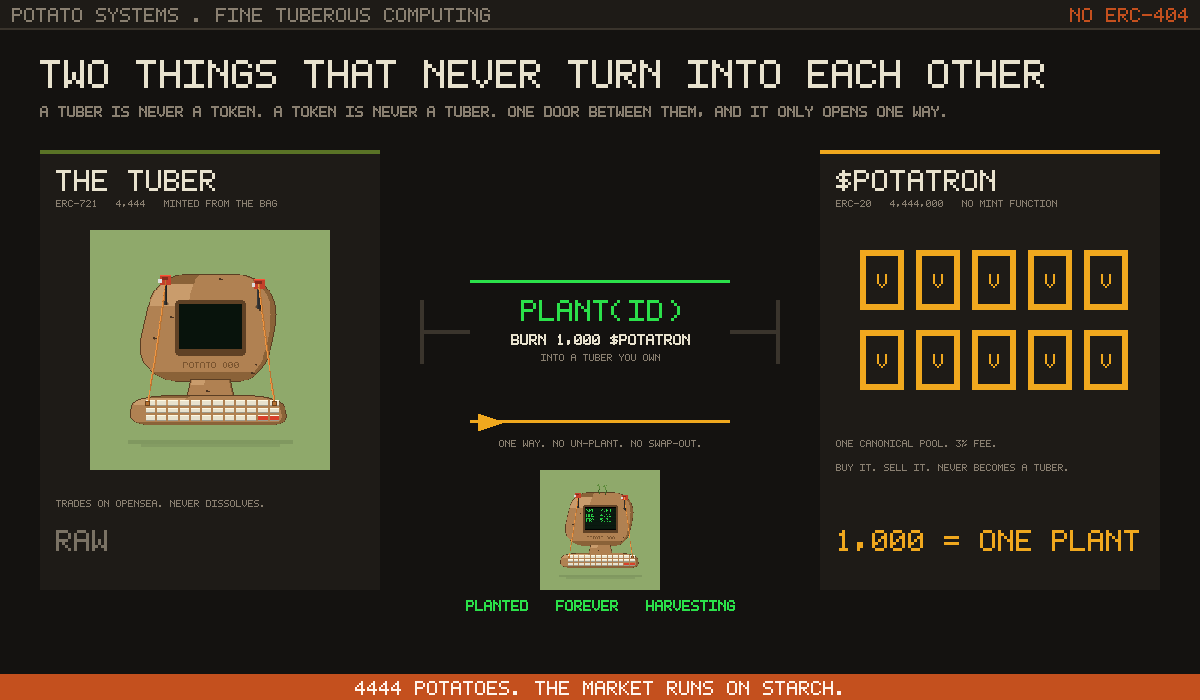
That is the whole system: a mint with a seed-bag draw, a one-way commitment for holders, a fee engine that cannot be routed around, and a potato that gets heavier the longer it sits in the ground.
Glossary Copy link
The vocabulary is proprietary on purpose. Every term used on this site:
- Tuber
- One unit of the collection. One id, one image, one spec sheet. 4444 exist as plain ERC-721s. Never a token.
- $POTATRON
- The ERC-20. 4,444,000 units, fixed, no mint function. Bought and sold in one canonical pool with a 3% fee. Never becomes a tuber.
- Raw tuber
- A minted tuber that has not been planted. Trades freely as an NFT, has no token inside, earns nothing. Screen dark.
- Planted tuber
- A tuber whose owner burned 1,000 $POTATRON into it. Permanent, still freely transferable, and the only state that harvests. The screen lights up.
- Dig
- Minting. One random draw from the seed bag per tuber. What you dig is what you keep — there is no reroll.
- Seed bag
- The pool of unminted ids. A lazy Fisher–Yates shuffle; public state, so the odds are checkable at any moment.
- Harvest
- The 2% of trading volume that accrues to planted tubers, paid in each track's tokenized agribusiness stock.
- Harvest epoch
- One batch conversion of queued WETH fees into the ten stocks through sealed converter routes.
- Water
- A permissionless call that re-prices a tuber's boosts from live balances. Anyone can water any planted id.
- Chassis
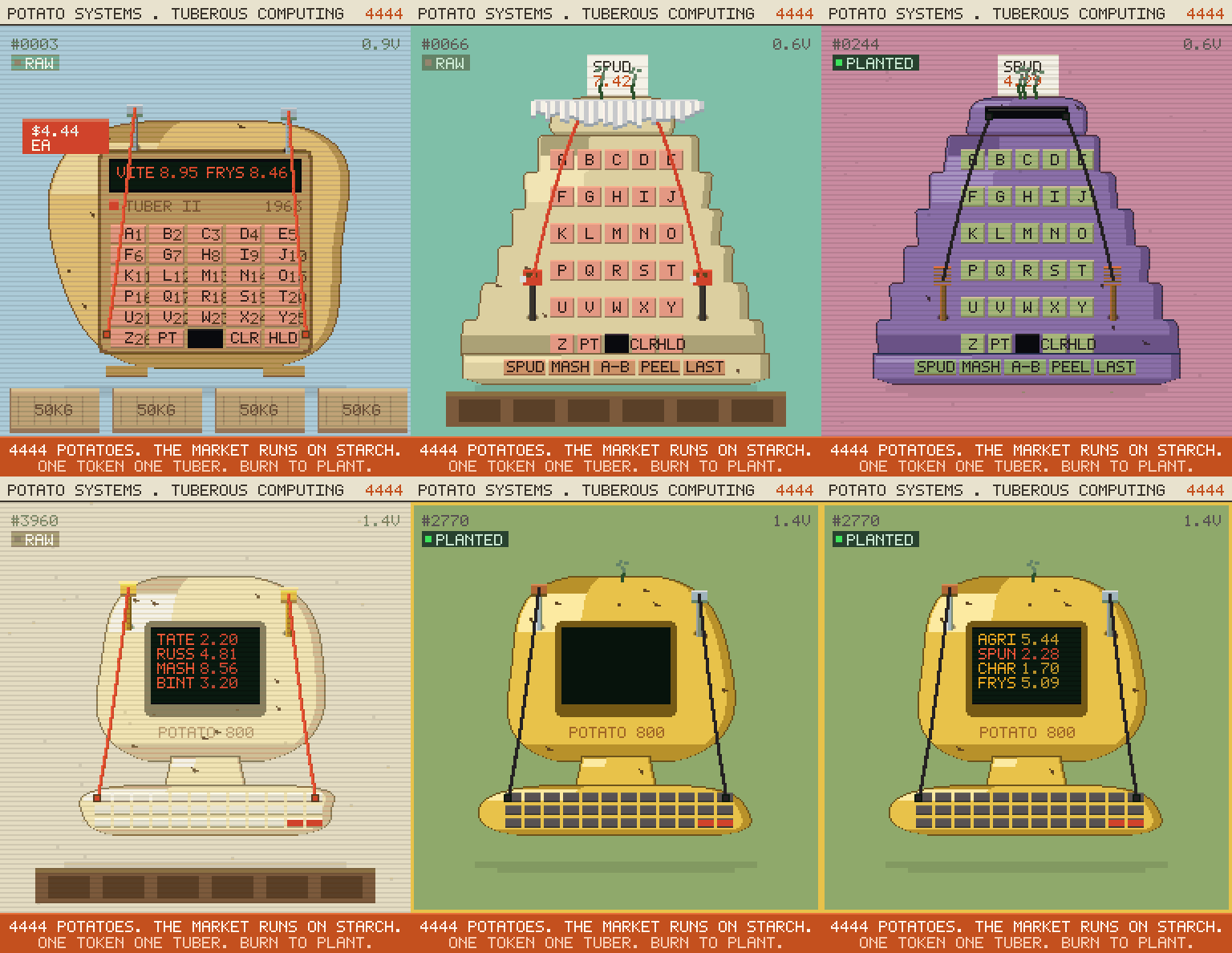
- The machine model a tuber is drawn as. Four exist: SPUD I KEYPAD, TUBER II DESK UNIT, POTATO 800, MASHDAQ TERMINAL.
- Variety
- The potato the chassis is grown from. Drives the body palette: Russet, King Edward, Yukon Gold, Red Bliss, Blue Congo, and so on. One variety, GOLD RELIC, is the rarest thing in the collection.
- Electrodes
- The power supply. Galvanized nail, copper and zinc, copper coil, croc clips, zinc strip, gold probe, or the lemon backup.
- Sprouts
- What is growing out of the top. Trimmed through overgrown; a few are chitted, glowing or flowering.
- Bench
- What the machine is standing on: clean bench, dirt, seed tray, sack stack, hydro tray, compost, peel pile.
- Readout
- What the screen or slip is showing. Ticker tape, bid and ask, a fries chart, the starch index, or the dreaded STARCH FAULT.
- Voltage
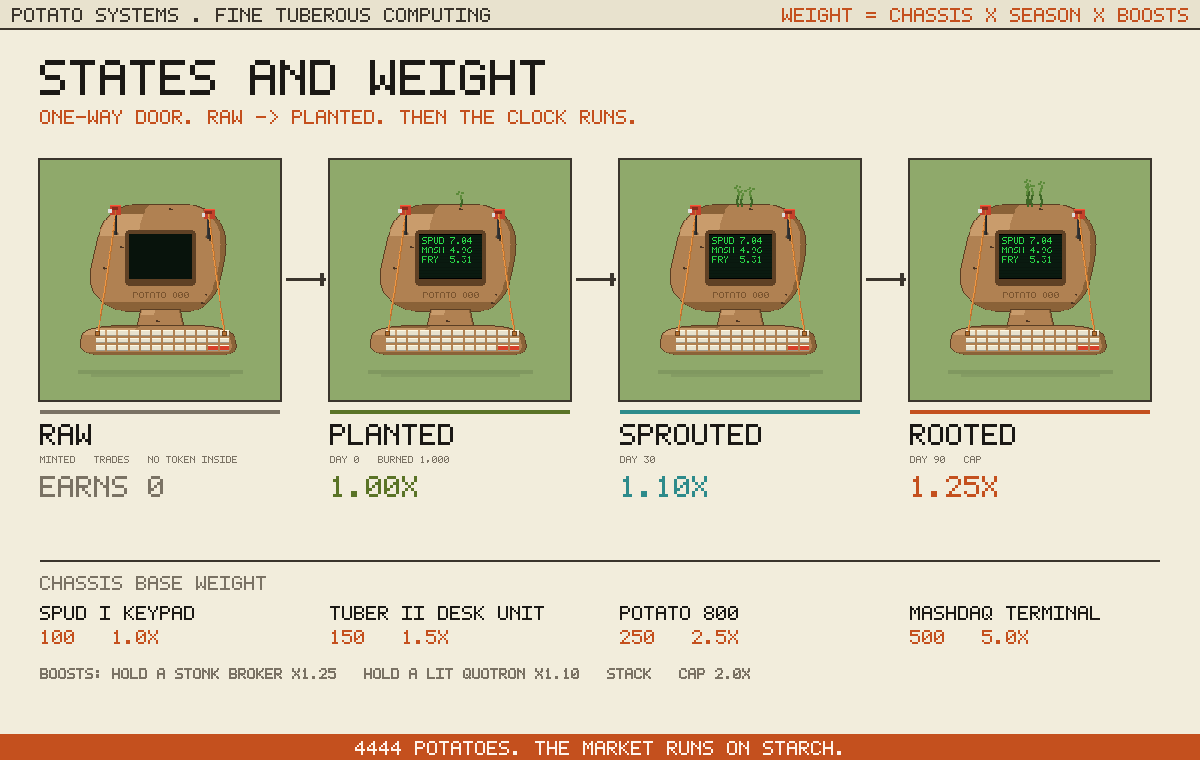
- The chassis weight, printed on every unit: 0.6V / 0.9V / 1.4V / 2.2V map to harvest weight 1.0x / 1.5x / 2.5x / 5.0x.
- Season
- Time since planting. Day 0 = PLANTED (1.00x), day 30 = SPROUTED (1.10x), day 90 = ROOTED (1.25x, cap). The clock travels with the tuber.
- Harvest track
- One of ten groups of 444 tubers, named after a seed potato and assigned a single agribusiness stock token (LW, DE, ADM, CTVA, NTR, BG, MOS, CF, INGR, MOO). Printed in the metadata as SEEDSTOCK.
- Relic
- One of four one-of-one machines at ids 4441–4444, drawn by hand, with their own harvest streams instead of a track assignment.
- Tier
- A rarity band computed from how uncommon a tuber's full trait set is: COMMON, UNCOMMON, RARE, EPIC, LEGENDARY.
The Machines Copy link
Every chassis is a real terminal from the history of stock quotation, rebuilt around a potato. Rarer chassis carry more harvest weight: 1.0x, 1.5x, 2.5x, 5.0x.
| Chassis | Year | Share | Volts | Catalog line |
|---|---|---|---|---|
| SPUD I KEYPAD | 1961 | 44% | 0.6V | No screen. Type a ticker, the answer prints on a slip. Electronics that draw letters cost a fortune; paper is forever. |
| TUBER II DESK UNIT | 1963 | 30% | 0.9V | Twenty-four kilobytes of pure starch. A segment display and a numbered keypad on a desk-sized tuber. |
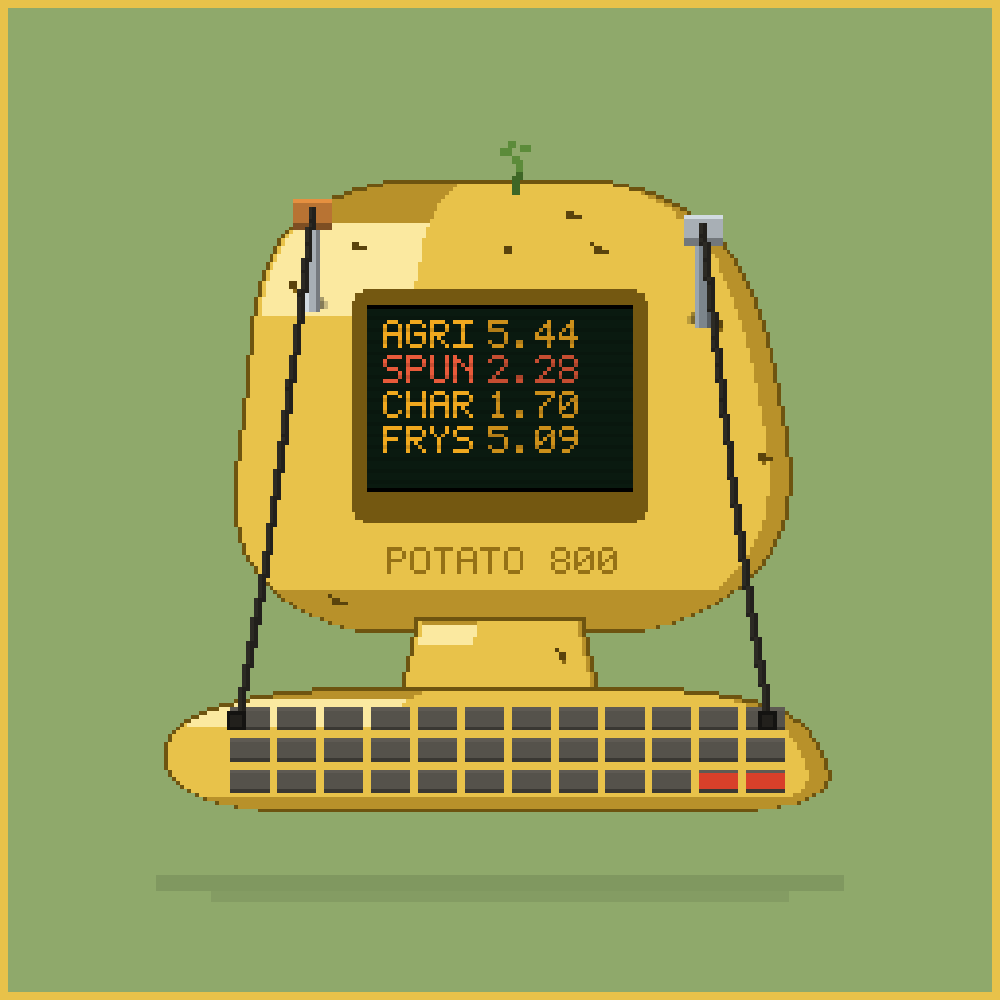
| POTATO 800 | 1970 | 18% | 1.4V | The future has a screen now, and roots. A genuine cathode ray tube set into the potato. Glows green. |
| MASHDAQ TERMINAL | 1971 | 8% | 2.2V | Every dealer, every quote, one tuber. Twin mainframes on a rack of fifty-kilo sacks. The whole market on one screen. |
The history behind the models
The 1960 Quotron I had no screen at all: you typed a ticker on a keypad and the answer printed on a paper slip. The Quotron 800 brought the CRT. The 1971 NASDAQ terminal, fed by twin mainframes over twenty thousand miles of leased line, was the first time a dealer could see the whole market's quotes at once. Our lineage runs a year behind on each, because the potato had to be found first.
The power supply is older than all of them. Volta stacked zinc and copper discs in 1800 and got a current; a potato does the same job with less ceremony, which is why every school on earth has wired one to a bulb. POTATOTRONS just wires it to a terminal.
Anatomy Of A Tuber Copy link
Twelve drawn layers and five derived fields make up every spec sheet. All of them are frozen in the metadata at mint.
| Layer | Values |
|---|---|
| MODEL | SPUD I KEYPAD · TUBER II DESK UNIT · POTATO 800 · MASHDAQ TERMINAL |
| VARIETY | Russet · King Edward · Yukon Gold · New Potato · Red Bliss · Fingerling · Sweet · Blue Congo · Purple Majesty · Mash White · Gold Relic |
| BACKGROUND | Burlap · Cream · Haze · Fry · Sprout · Sky · Butter · Lilac · Field · Beet · Greenhouse · Soil · Root Cellar |
| KEYCAPS | Bone · Olive · Salmon · Sky · Butter · Mint · Clay · Lilac · Char |
| ELECTRODES | Galvanized Nail · Twin Nail · Copper + Zinc · Copper Coil · Croc Clips · Zinc Strip · Gold Probe · Lemon Backup |
| SPROUTS | Trimmed · One Eye · Two Eyes · Bushy · Overgrown · Chitted · Glowing · Flowering |
| BENCH | Clean Bench · Dirt Clumps · Seed Tray · Sack Stack · Hydro Tray · Compost · Peel Pile |
| READOUT | Ticker Tape · Bid And Ask · All Green · All Red · Fries Chart · Starch Index · Boiling · Starch Fault · Golden Quote |
| CABLE | Copper · Black · Zinc · Red · Green · Yellow · Ribbon |
| EXTRA | None · Soil Dust · Foil Wrap · Fry Antenna · Steam Vent · Butter Pat · Seed Bag · Price Sticker · Grafted Root · Gold Leaf |
| STATUS | Raw · Planted |
| SEEDSTOCK | One of the ten seed varieties below |
| Derived | VOLTAGE · YEAR · WEIGHT · TIER · RARITY SCORE |
Rarity Copy link
Each layer is rolled from a published weight table. A tuber's rarity score is the sum, over all twelve layers, of one over the frequency of the value it rolled; tiers are cut at fixed score thresholds. The counts below are exact, because the generator is deterministic and has been run over all 4444 ids.
| Tier | Units | Share | Score |
|---|---|---|---|
| COMMON | 3312 | 74.5% | < 105 |
| UNCOMMON | 679 | 15.3% | 105 – 122 |
| RARE | 319 | 7.2% | 123 – 178 |
| EPIC | 103 | 2.3% | 179 – 210 |
| LEGENDARY | 31 | 0.7% | ≥ 211 |
Seventeen tubers roll the GOLD RELIC variety: gold chassis, gold frame, and a spot in LEGENDARY regardless of what else they rolled. They are generator output, not the four hand-drawn relics.
Tier is a description of the picture. Harvest weight is set by the chassis alone (see Voltage), not by tier.
Seed Varieties Copy link
Every tuber belongs to one of ten tracks of exactly 444 units, named after real seed potatoes and printed in the metadata as SEEDSTOCK. Every track carries the same chassis mix (245 / 133 / 53 / 13) and each receives an equal share of every harvest epoch. What differs is the stock the track pays — see the ten harvest stocks.
The Relics Copy link
Four machines at ids 4441–4444 are not generator output. They are drawn by hand, one of one each, revealed at mint, and they do not sit on a track: the three basket relics split 12.5% of every epoch equally, and the Golden Tuber takes 5% paid in all ten stocks at once.
| Id | Relic | Year | What it is |
|---|---|---|---|
| 4441 | THE GALVANI FROG | 1780 | The first accidental battery. A frog leg, two metals, a twitch. The quotation terminal it powers is very small. |
| 4442 | THE VOLTA PILE | 1800 | Zinc, copper, brine-soaked cardboard, stacked to the ceiling. The only relic with no potato at all. |
| 4443 | THE LEMON | 1959 | The science-fair alternative. Wired to a keypad out of spite. Sour readout. |
| 4444 | THE GOLDEN TUBER | 1971 | A MASHDAQ on a solid gold potato. Top shelf. One made. |
$POTATRON Copy link
An ERC-20 with 4,444,000 units. There is no mint function in the deployed bytecode, no team allocation, no vesting, no presale. At launch 100% of the supply is deposited as the token side of the canonical POTATRON/WETH pool, paired with 100% of the mint ETH, and the position is locked forever. The creator takes nothing from the mint.
| Supply | 4,444,000 | fixed; no mint function |
|---|---|---|
| Plant cost | 1,000 | per tuber. 4444 × 1,000 = the entire supply: if every tuber were planted, the token would cease to exist |
| Market | one pool | POTATRON/WETH on Uniswap v4, reached only through the immutable canonical router |
| Fee | 3% | permanent, on the WETH side of every swap, taken inside the swap by the hook |
| Transfers | 0% | no transfer tax, no blacklist, no pause on transfers |
The 4,444,000 invariant. Liquid tokens plus planted tubers × 1,000 always equals 4,444,000. Every unit is in exactly one of two states: liquid (tradable, generating fees) or planted (a permanent claim on those fees). Planting does not destroy value — it moves a unit out of the float into a claim on the float's trading activity.
function economicUnits() external view returns (uint256) {
    return totalSupply + totalPlanted * PLANT_COST;   // always 4,444,000e18
}
Plant, Grow, Harvest Copy link
Raw tubers trade and earn nothing. Planting burns 1,000 $POTATRON from the wallet that owns the tuber. In exchange the tuber becomes permanent, its screen lights up, and it starts harvesting its track's stock. Nothing is escrowed: the tuber stays in your wallet, stays transferable, and pending harvest travels with it. This is one-way. There is no function in any deployed contract that un-plants a tuber, and no function that turns a tuber back into tokens.
Seasons
A planted tuber's weight is its chassis base (100 / 150 / 250 / 500) times a season multiplier: 1.00x at planting, 1.10x after 30 days (SPROUTED), 1.25x after 90 days (ROOTED, the cap). The clock belongs to the tuber, not the wallet — selling a rooted tuber sells a rooted tuber. Boosts from the alliance multiply on top, capped at 2.0x in total.
How to plant, step by step
- Hold the raw tuber you want to commit and at least 1,000 $POTATRON in the same wallet.
- On the Field page, select the tuber and hit PLANT, or call
plant(id)on the token contract from any wallet UI. - The transaction burns 1,000 $POTATRON from supply (not to a dead address —
totalSupplygenuinely falls), starts the season clock, clears any outstanding approval on the id, and registers the tuber with the harvest engine at the current accumulator mark. - Harvest accrues from that mark forward. Read it any time with
pending(id); claim withharvest(id)from the owning wallet.
Pending harvest travels with the tuber when the NFT moves; a seller may claim right before a sale, so buyers should re-check pending balances at execution time.
Where Every Volt Goes Copy link
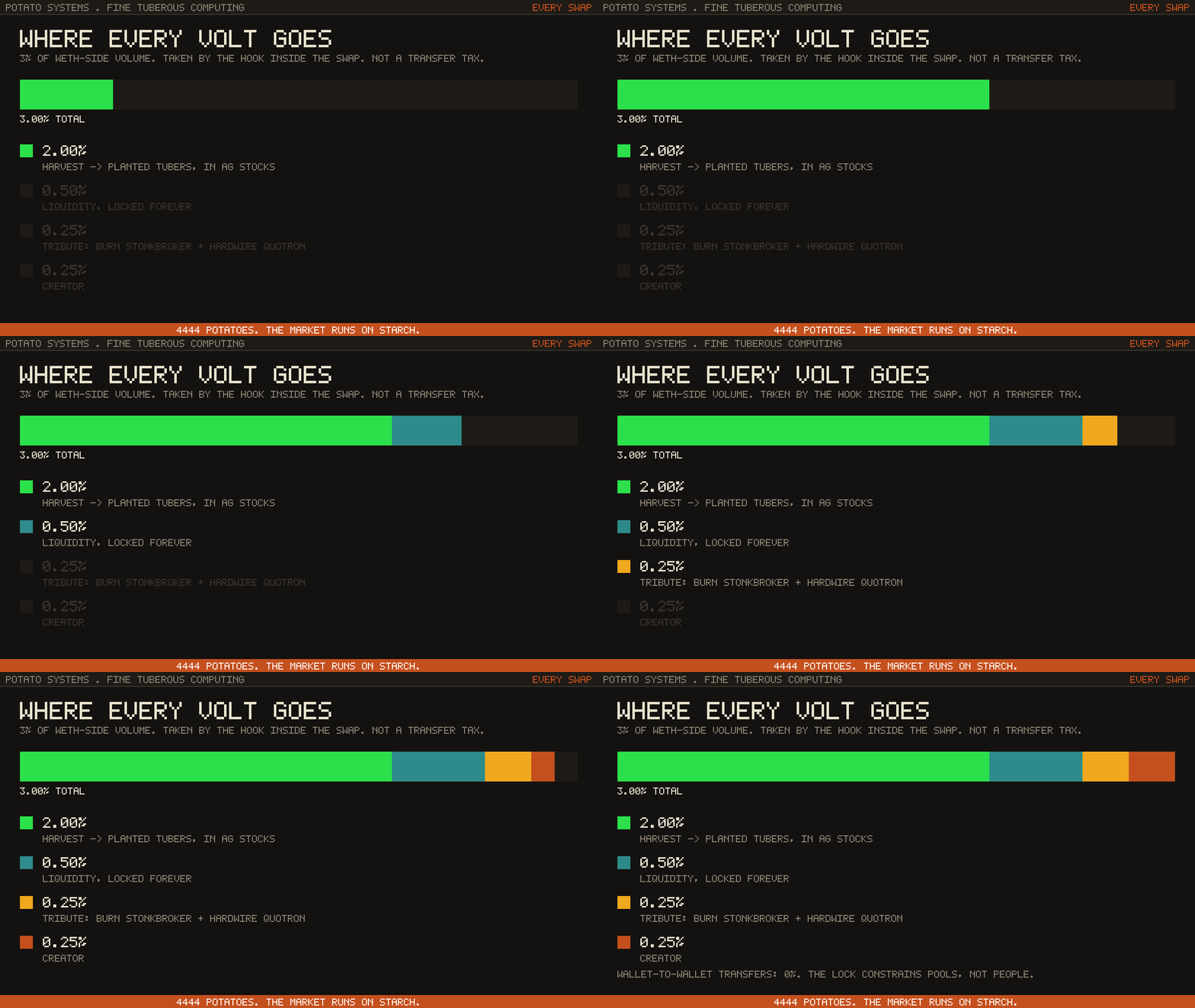
The permanent base fee is 3% of WETH-side volume, taken by the hook inside the swap itself. The pool's own LP fee is forced to zero and the protocol fee replaces it. It is a swap fee, not a transfer tax: wallet-to-wallet $POTATRON and NFT transfers pay nothing.
| Share of volume | Destination | Pot |
|---|---|---|
| 2.00% | Harvest — planted tubers and relics, paid in agribusiness stock | harvest pot → sealed converter → reflections contract only |
| 0.50% | Liquidity reinvest, permanently locked | LP vault |
| 0.25% | Tribute: 0.125% buys and burns $STONKBROKER, 0.125% funds QUOTRON hardwires | tribute vault |
| 0.25% | Creator | taken inside the swap, no custody step |
The retained streams accumulate in destination-locked pots on the hook: only the harvest sink can pull the harvest pot, only the LP vault the LP pot, only the tribute vault the tribute pot. There is no arbitrary sweep function.
One harvest epoch
Fees queue in WETH. An epoch can open when at least 0.1 WETH is queued, is capped at 100 WETH, and at least 60 seconds must pass between openings. The budget is split equally across the ten sealed stock routes. Inside each track: 82.5% to planted tubers by live weight, 12.5% split equally among the three basket relics, 5% to the Golden Tuber in all ten stocks.
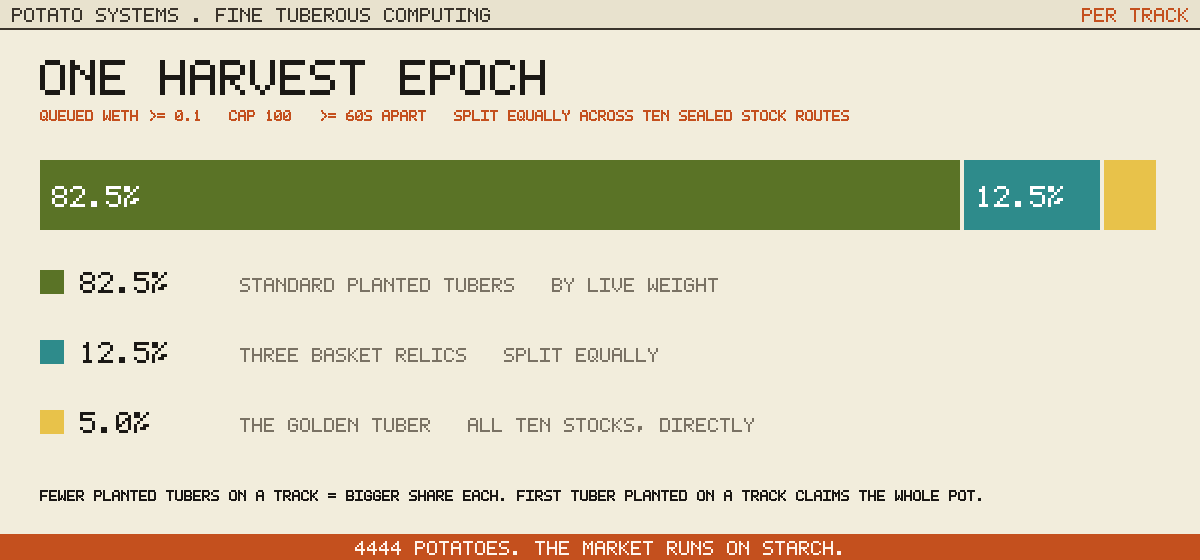
Fewer planted tubers on a track means a larger share of that track's stock per tuber. The first tuber planted on a track claims the entire pot. Ten tracks, ten pots, ten races.
The Ten Harvest Stocks Copy link
Only agribusiness. If it grows, moves, feeds or fertilizes a potato, it qualifies. Each track holds exactly 444 tubers with an identical tier mix and receives an equal epoch budget.
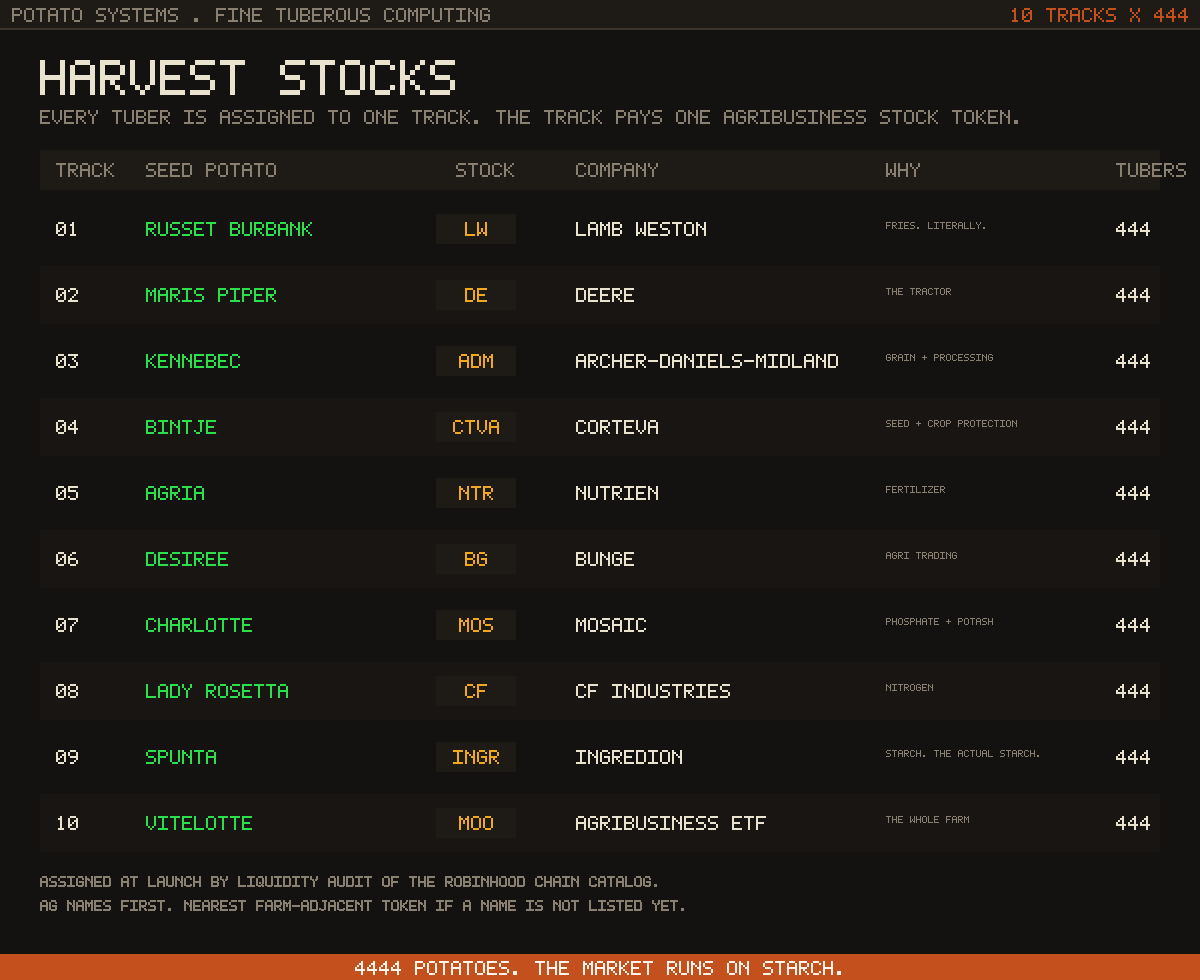
| Track | Seed potato | Stock | Why |
|---|---|---|---|
| 01 | RUSSET BURBANK | LW · Lamb Weston | Fries. Literally. |
| 02 | MARIS PIPER | DE · Deere | The tractor. |
| 03 | KENNEBEC | ADM · Archer-Daniels-Midland | Grain and processing. |
| 04 | BINTJE | CTVA · Corteva | Seed and crop protection. |
| 05 | AGRIA | NTR · Nutrien | Fertilizer. |
| 06 | DESIREE | BG · Bunge | Agri trading. |
| 07 | CHARLOTTE | MOS · Mosaic | Phosphate and potash. |
| 08 | LADY ROSETTA | CF · CF Industries | Nitrogen. |
| 09 | SPUNTA | INGR · Ingredion | Starch. The actual starch. |
| 10 | VITELOTTE | MOO · Agribusiness ETF | The whole farm. |
The ten stocks are assigned at launch by an on-chain liquidity audit of the Robinhood Chain stock-token catalog, agribusiness names first. If a name is not listed on the chain by launch, its track receives the nearest farm-adjacent token that is, and the substitution is published with the assignment hash. The converter can send stock only to the harvest reflections contract; the destination is immutable.
Harvest Epochs
Trading fees are taken in WETH and queue in the hook's harvest pot. A dedicated executor converts them to the ten harvest stocks in epochs: an epoch can open only when at least 0.1 WETH is queued, is capped at 100 WETH, and at least 60 seconds must pass between openings. The opened budget is split equally across the ten sealed stock routes.
Where each converted dollar lands
- Each track sends 82.5% of its converted stock to ordinary planted tubers by live harvest weight.
- 12.5% is split equally among the three basket relics.
- 5% accrues to THE GOLDEN TUBER, which receives all ten tokenized stocks directly.
The converter can send stock only to the harvest contract — the destination is immutable. Pending rewards stay attached to a planted tuber id when that NFT transfers.
The Seed Bag (The Dig) Copy link
Tubers are minted, not materialized. Minting pulls an id from the seed bag — a lazy Fisher–Yates shuffle over the unminted ids, indexed with a hash of the previous block's randomness, the timestamp, the recipient and a nonce. The four relics sit in the bag like any other id until someone draws them.
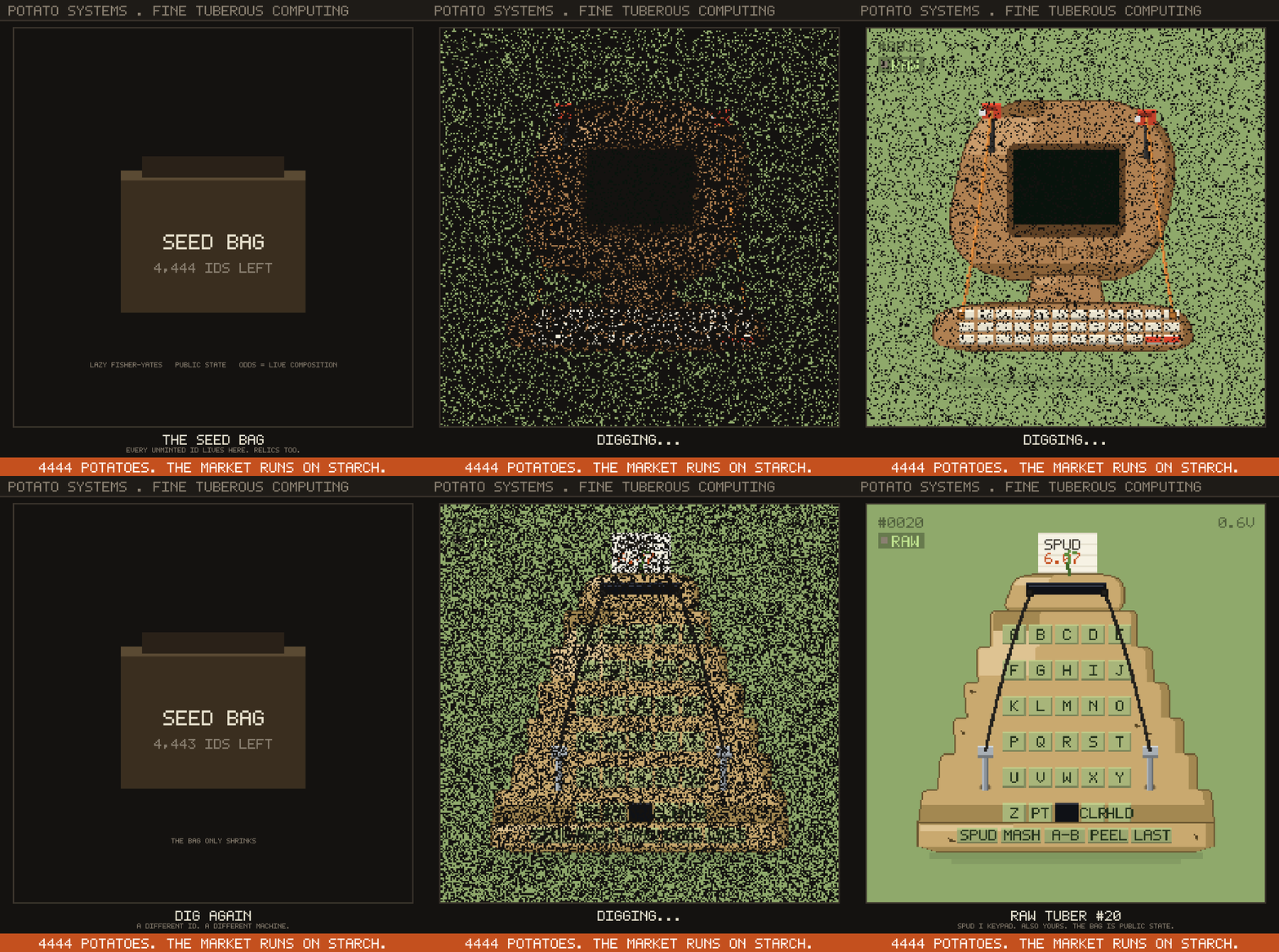
The odds are exactly the bag's live composition, and the bag is public state, so they are checkable at any moment. The bag only ever shrinks. There is no reroll: what you dig is what you keep, and the only ways to change machines are the marketplace or another dig.
This is pseudorandomness drawn from block state, not an oracle; it is unpredictable enough for a draw whose prizes share one fee stream, and every dig is auditable after the fact. Once the bag is empty, the only way to get a tuber is secondary. Raw tubers on secondary come with nothing attached — planting is the buyer's decision and the buyer's burn.
The Alliance Copy link
POTATOTRONS sits alongside the two collections it grew from. Brokers stared at Quotrons for thirty years; both of them ate potatoes.
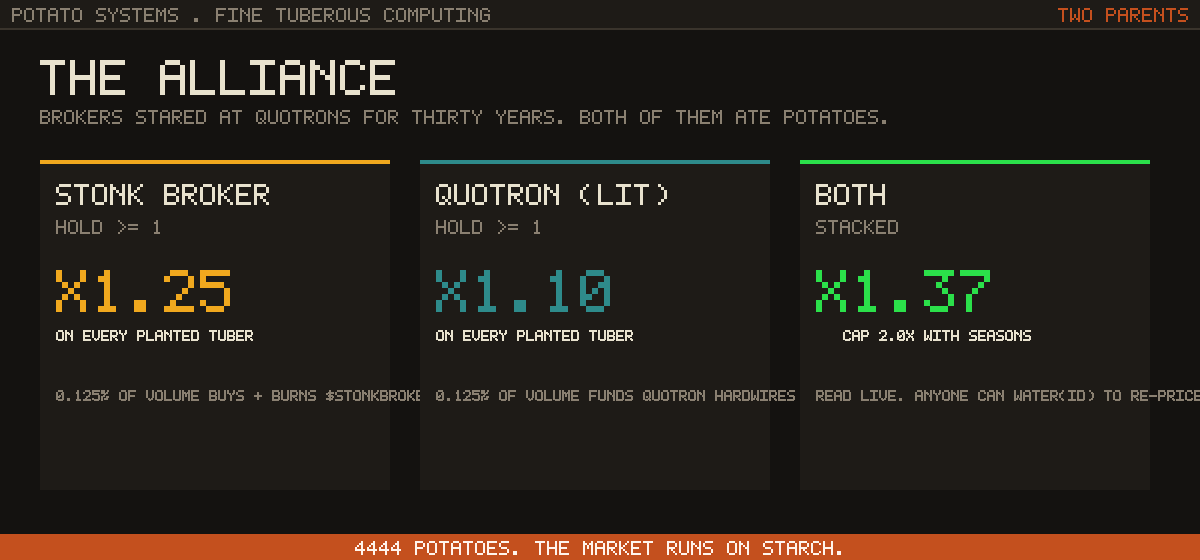
- Broker boost: hold at least one STONK BROKER and every tuber you planted harvests at 1.25x, read live from the Broker contract.
- Quotron boost: hold at least one lit QUOTRON and every tuber you planted harvests at 1.10x. The two stack to 1.375x; with seasons the total weight caps at 2.0x.
- Tribute: of every swap, 0.125% buys and burns $STONKBROKER, and 0.125% buys $QUOTRON into the tribute vault. Every time the vault holds a whole unit it hardwires the terminal it materialized, and that terminal's stock reflections flow into the harvest pot. The vault never sells; Potatotrons ends up holding a growing rack of lit Quotrons that pay planted tubers. Forever.
Boosts are checkpointed at plant, transfer and claim, and anyone can call water(id) to re-price a stale boost. Sell your Broker and expect to be watered.
The Routing Lock
The supported market is one registered POTATRON/WETH Uniswap v4 pool reached through the immutable canonical router. What makes that claim unusual is where it is enforced: in the token. $POTATRON refuses to settle anywhere else.
Every Uniswap v4 pool — ours or a rogue one — settles through the same PoolManager singleton. An address allowlist cannot tell our pool from a copycat pool. So the token treats the PoolManager as locked by default, and our hook unlocks it one swap at a time: during each swap through the registered pool, the hook writes a settlement allowance into the token — bound to the exact direction and amount of that swap, stored in transient storage so it cannot outlive the transaction. A rogue v4 pool's swaps run without our hook, so no authorization is ever written, so the settlement reverts. It cannot trade $POTATRON — and because seeding a pool is itself a transfer to the PoolManager, it cannot even be seeded.
What the lock does not cover. A v2- or v3-style pair never touches the PoolManager, so the lock cannot see it. Known non-v4 venue archetypes are refused by runtime codehash instead — an owner action that can only target contract code, never a person: EOA codehashes are unbannable by construction. The codehash ban is reactive; a novel AMM contract would work until identified and banned. Ordinary ERC-20 and NFT transfers remain possible, always. The lock constrains pools, not people.
NFT Transfers and Creator Earnings
The tuber collection uses ERC721-C transfer validation. Compatible marketplace sales enforce a 5% creator earning: 4% to the harvest pot through the royalty converter, 1% to the creator. This is separate from the creator's 0.25% share of canonical volume.
ERC721-C is enforced by venue restriction, not by advisory ERC-2981 metadata: a transfer initiated by a non-allowlisted operator reverts, so a tuber cannot be listed on a marketplace that strips royalties at all. Wallet-to-wallet transfers you initiate yourself always pass — the validator gates operators, not owners. Marketplace compatibility is venue-specific. The transfer validator and the metadata base URIs are immutable once launched.
Royalties arriving at the splitter release permissionlessly in the immutable 80/20 proportion — anyone can call releaseToken. The harvest share is converted through sealed routes whose only possible destination is the royalty harvest contract, then claimed by planted tubers exactly like trading-fee rewards.
Trust Assumptions Copy link
These are disclosed trust assumptions, not claims of full decentralization. We would rather you read them here than discover them in the source.
- The owner can pause the fee hook (not the token, not transfers), ban or unban non-EOA venue codehashes, and irreversibly finalize the public fee at 3% — which executes in the launch transaction. EOA codehashes are unbannable by construction: wallet-to-wallet transfers can never be blocked.
- No blacklist, no recovery admin, no forced moves. There is no function in any deployed contract that can freeze an address or move a balance or a tuber that is not yours. No mint function on the token, no hidden tax, no upgradeable proxy in the fee path.
- Liquidity — the initial position (mint ETH + 100% of supply) and every LP reinvest — is held by a vault with no withdrawal path. Permanent.
- The canonical pool is enforced in the token: the PoolManager is locked by default and the hook unlocks it one swap at a time with a transient, amount-bound authorization. A rogue v4 pool cannot trade $POTATRON and cannot even be seeded.
- Two hops in the harvest path are keeper-initiated: converting queued WETH into the ten stocks, and pulling marketplace royalties through the royalty converter. If the keeper stops, fees keep accruing in destination-locked pots — nothing is stealable — but nothing pays out until it resumes.
- Marketplace sales enforce a 5% creator earning through ERC721-C: 4% to the harvest pot, 1% to the creator. Wallet-to-wallet transfers you initiate always pass.
- Which machine each id is, which track it harvests, and its art are fixed before launch and committed on-chain as a hash. Nothing is reassigned after the fact.
Security Controls and Trust Assumptions
These are disclosed trust assumptions, not claims of full decentralization. We would rather you read them here than discover them in the source.
- Owner can pause the fee hook (not the token, not transfers), ban or unban non-EOA venue codehashes, and irreversibly finalize the public fee at 3%. Fee finalization executes in the launch transaction.
- No blacklist. No recovery admin. No forced moves. There is no function in any deployed contract that can freeze an address or move a balance or a tuber that is not yours.
- No mint function on the token. No hidden tax. No upgradeable proxy in the fee path — the token, hook, router, and tuber collection are immutable.
- Keeper runs conversions and epochs. If the keeper stops, fees accrue safely in destination-locked pots; nothing can be stolen, and nothing can be paid out until it runs again. Any address may be authorized as a keeper by the owner; the keeper cannot choose destinations.
- Liquidity — the initial position (mint ETH + 100% of supply) and every LP reinvest — is held by a vault with no withdrawal path. Permanent.
Whitelist And Mint Copy link
The whitelist is the only allocation mechanism. There is no presale token, no points program, no raffle. Applications are filed through the form above and reviewed by hand against the like and repost lists before the snapshot.
What gets you removed
- A handle that unliked or deleted the repost before the snapshot.
- The same wallet or handle filed twice. Later copies are dropped; the first stays.
- Accounts created after the announcement post with no other activity.
Mint
Chain: Robinhood Chain. The tubers are an ERC-721 collection with ERC721-C transfer validation; there is no ERC-404 and no token-to-NFT conversion anywhere in the stack. Whitelisted wallets mint first (max 2 per wallet in the WL window), then a public window opens (max 5 per transaction). The price is fixed at launch and published on-chain 48 hours before the WL window. 100% of mint ETH seeds the canonical POTATRON/WETH pool together with 100% of the token supply, locked forever; $POTATRON trading opens in the same launch transaction, which also freezes the metadata. Date and price are announced on X first and updated in the census above.
Verify It Yourself Copy link
The collection is not a folder of images that could be swapped. It is a program. The generator takes an id, hashes it into a seed, rolls every layer from the published weight tables and draws the picture on a 256-unit grid. Run it again for the same id and you get the same bytes.
Before mint, the assignment file (id → traits, for all 4444) is hashed and the hash is published here and on X. After reveal, hash the metadata yourself and compare:
sha256sum metadata.json
# expected: published before mint, pinned at reveal
The eight machines on this page are drawn live by the same generator code, in your browser. Open the console and call POTATOTRONS.rollToken(2770) if you want to see the spec sheet of the unit on the banner.
Risks
Harvest and reward drops are promotional rewards for taking part in the protocol. They are not dividends, not investment income, and confer no equity, ownership, or share of profits in any company.
- Planting is irreversible. The burned token is gone whether or not the protocol ever earns another cent.
- Per-tuber reward rates dilute as more tubers plant: each new planted tuber adds a permanent claimant while removing liquid supply from the float that generates fees. Early per-tuber rates are not representative.
- The tokenized stocks are issued by a third party as upgradeable contracts. Their issuer can pause or alter them, and that risk passes through to anything denominated in them.
- The agribusiness catalog on Robinhood Chain is not guaranteed. Tracks may launch with farm-adjacent substitutes under the published catalog rule.
- Reward conversion and royalty processing are keeper-initiated. Fees accrue safely if operations stop, but payouts require the keeper to run.
- Liquidity on Robinhood Chain moves fast. Conversion routes can thin out, the canonical market can be volatile, and rewards depend entirely on trading volume that may never materialize.
- Canonical v4 settlement is enforced and known alternate venue codehashes can be blocked, but arbitrary future custom contracts cannot be represented as categorically impossible.
- ERC721-C marketplace compatibility varies. Unsupported venues may reject transfers or listings.
- Access to tokenized-stock products is restricted in some jurisdictions, including the United States. Users are responsible for their own legal eligibility.
- This is experimental software. Never risk more than you can afford to lose completely.
PLANT YOURS TODAY . ROOTED TUBERS BOOT FOREVER . POTATOTRONS
FAQ Copy link
Is there a token?
Yes: $POTATRON, an ERC-20 with 4,444,000 units and no mint function. It is not an ERC-404 — holding tokens never gives you a tuber, and a tuber never turns into tokens. The only thing that connects them is plant(id), which burns 1,000 $POTATRON into a tuber you already own. The only contract addresses that count are the ones published on this page and on X; anything else is not ours.
Can I turn my tuber into $POTATRON, or my $POTATRON into a tuber?
No, in both directions. Tubers are minted from the seed bag and traded as NFTs. $POTATRON is bought in the pool. The one door between them is planting, and it only opens one way.
If I sell my $POTATRON, what happens to my tuber?
Nothing. A raw tuber has no token attached; a planted tuber's tokens were burned. Token movement never touches tubers.
What does a planted tuber earn?
Its track's agribusiness stock token — Lamb Weston, Deere, Ingredion and so on — from 2% of every swap in the canonical pool, weighted by chassis, season and alliance boosts. Read it with pending(id), claim with harvest(id).
Can I un-plant?
No. Planting burns 1,000 $POTATRON and there is no function in any deployed contract that reverses it. It is not staking: nothing is escrowed and there is nothing to unwind. The tuber stays a permanent NFT and keeps harvesting for whoever holds it.
If I buy a planted tuber, do I get its season?
Yes. The season clock belongs to the tuber. A rooted tuber you buy is rooted in your wallet, and unclaimed harvest travels with it — though a seller can claim right before the sale, so check pending(id) at execution time.
Why only agribusiness stocks?
Because the machine runs on a potato. Fries, tractors, seed, fertilizer, starch. If a name is not on Robinhood Chain by launch, the track gets the nearest farm-adjacent token and we publish the substitution.
How do I get whitelisted?
Like and repost the announcement post, then file the form above with the link to your repost and your wallet. One handle, one wallet. Review happens before the snapshot.
Can I change my wallet later?
Not after the snapshot. Before it, file again from the same handle and the newer wallet replaces the older one.
Which chain?
Robinhood Chain, as an ERC-721 collection. Any EVM wallet address works on the form.
Is this affiliated with QUOTRONS?
POTATOTRONS is a fan derivative of QUOTRONS by cruelhand. It borrows the catalog voice and the idea of drawing real quotation machines; it is not made by, endorsed by or connected to the QUOTRONS team.
Why potatoes?
Because a potato can run a bulb, and a bulb is most of a terminal.
Brand Assets Copy link
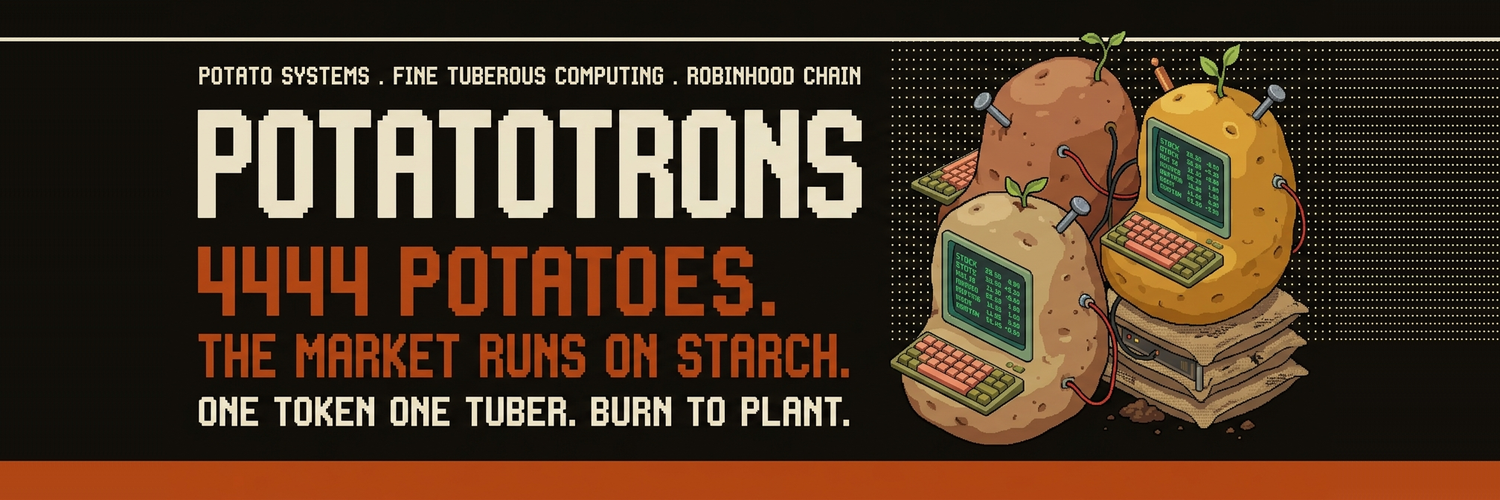
Palette, rails and type are free to use for fan art, memes and derivatives of the derivative. Please do not use them to imply an official mint page.
POTATO SYSTEMS . FINE TUBEROUS COMPUTING . ROBINHOOD CHAIN
4444 POTATOES. THE MARKET RUNS ON STARCH.
ONE TUBER. ONE NAIL. ONE HONEST VOLT.
BURN 1,000. PLANT FOREVER.
PLANT YOURS TODAY . ROOTED TUBERS BOOT FOREVER
Avatar: avatar.png · Banner: banner.png · Announcement GIF: post.gif